
Product code: ENP030C
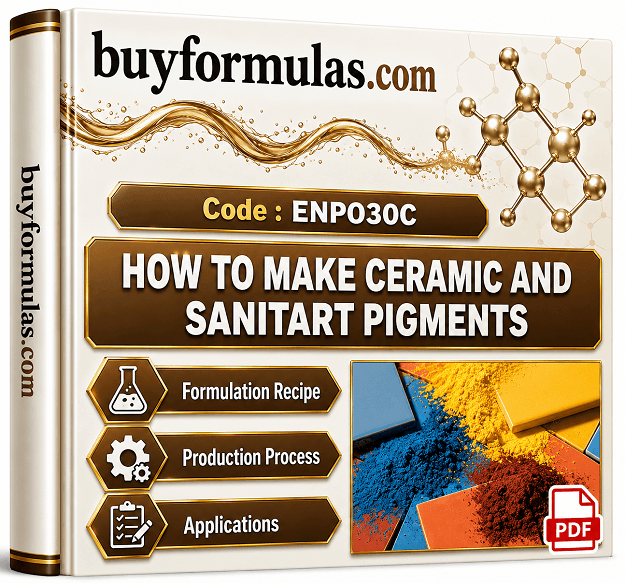
Discover the secrets of manufacturing ceramic and sanitary ware pigments in a variety of colors, characterized by colorfastness under heat and resistance to reaction with oxides.
Full Formula & Ingredients
Detailed with quantities
Delivery within 72h
Straight to your email
Secure Payment
100% secure & safe
Lifetime Access
Read anytime, anywhere
PDF Format
Printable & offline access
Industrial ceramic pigments are specialized inorganic colorants engineered to withstand extremely high firing temperatures while maintaining exceptional color stability, chemical resistance, and long-term durability. These pigments are essential raw materials in the production of ceramic tiles, sanitary ware, porcelain, tableware, glass, refractory materials, and digital ceramic printing, where permanent color performance under severe thermal conditions is required. Unlike conventional organic pigments, ceramic pigments are manufactured through high-temperature solid-state reactions that produce stable crystalline structures such as Spinel, Zircon, Corundum, and Rutile phases. These mineral structures provide outstanding resistance to temperatures ranging from 900°C to 1300°C, while maintaining excellent color strength, resistance to chemical attack, and compatibility with ceramic glazes and clay bodies. Their exceptional thermal stability makes them ideal for modern ceramic manufacturing processes that require consistent color development after firing. This comprehensive technical guide presents practical manufacturing methods for producing a range of high-quality industrial ceramic pigments using readily available raw materials and cost-effective production techniques. Each formulation has been developed to provide reliable industrial performance suitable for ceramic factories, pigment manufacturers, and technical laboratories involved in ceramic color production. The Book Covers the Manufacturing of the Following Ceramic Pigments
Cobalt Blue Spinel:
Premium cobalt-based blue pigment.
Exceptional thermal stability.
Brilliant deep blue color with excellent glaze compatibility.
Black Spinel:
High-temperature black ceramic pigment.
Suitable for glaze coloring and pigment blending.
Excellent opacity and color stability.
Chrome Green Spinel:
Intense chromium-based green pigment.
Outstanding resistance to high firing temperatures.
Suitable for porcelain, tiles, and sanitary ware.
Zirconium Vanadium Yellow (Zr-V):
Bright zirconium yellow ceramic pigment.
Excellent chemical and thermal stability.
Ideal for high-quality ceramic glazes.
Iron-Manganese Brown (Fe-Mn):
Stable brown ceramic pigment.
Suitable for floor tiles, porcelain, and architectural ceramics.
Excellent weather and heat resistance.
Key Features:
High-temperature resistance up to 1300°C.
Excellent color stability after firing.
Outstanding chemical and oxidation resistance.
Compatible with ceramic glazes and clay bodies.
Strong color intensity and excellent opacity.
Suitable for ceramic digital printing applications.
Stable inorganic mineral formulations.
Industrial-grade pigment quality.
Applications:
Industrial ceramic pigments are widely used in:
Ceramic wall and floor tiles.
Porcelain and tableware.
Sanitary ware.
Ceramic glazes.
Digital ceramic printing inks.
Colored clay bodies.
Glass decoration.
Architectural ceramics.
Heat-resistant ceramic coatings.
Refractory and specialty ceramic products.
Processing Methods:
The guide explains several practical methods for utilizing ceramic pigments in industrial production, including:
Mixing 5–10% pigment with ceramic glaze before firing.
Applying pigments for underglaze decoration using suitable binders such as CMC.
Incorporating 2–8% pigment directly into ceramic body formulations to produce colored clay.
Producing finely milled pigments suitable for digital ceramic printing inks.
Preparing heat-resistant ceramic and glass decorative coatings for firing applications.
What You Will Learn:
Fundamentals of ceramic pigment chemistry.
Selection of mineral raw materials.
Manufacturing procedures for industrial ceramic pigments.
High-temperature calcination techniques.
Milling and particle size control.
Quality control and color evaluation.
Firing behavior and pigment stability.
Practical production methods for commercial manufacturing.
Who Is This Book For? This guide is ideal for:
Ceramic pigment manufacturers.
Ceramic tile factories.
Sanitary ware manufacturers.
Ceramic glaze producers.
Chemical engineers.
Product development specialists.
Ceramic laboratories.
Entrepreneurs entering the ceramic materials industry.
Researchers and students specializing in ceramic technology.
Why This Book?
Unlike theoretical references, this guide focuses on practical industrial formulations that can be implemented directly in commercial production. Every formulation has been developed using industrial manufacturing principles and practical processing methods, enabling manufacturers to produce premium ceramic pigments with excellent thermal stability, color consistency, and commercial performance while using economical raw materials.
Technical Guide:
The manufacturing guide available on Buyformulas.com provides complete production procedures, raw material specifications, formulation details, processing parameters, calcination conditions, milling techniques, quality control methods, and practical production recommendations required to manufacture professional industrial ceramic pigments suitable for commercial ceramic applications. The complete technical guide is available in PDF format, written in professional technical English, with clear, practical, and application-oriented manufacturing instructions suitable for pigment manufacturers, ceramic engineers, product developers, research laboratories, and professionals working in the ceramics, coatings, and advanced materials industries.
|
✓
Complete Formulas
Full ingredients with exact quantities
|
✓
Manufacturing Process
Step-by-step production method
|
✓
Quality Control
Testing & specifications
|
|
✓
Production Cost
Detailed cost breakdown
|
✓
Packaging Guide
Storage & handling tips
|
✓
Technical Tips
Expert notes & troubleshooting
|
|
★★★★★ Excellent formula! Very detailed and easy to understand. Worked perfectly for our production. Jhon UK |
★★★★★ Highly recommended Complete guide with all technical details. Saved us weeks of testing. Amir Khan Pakistan |
★★★★★ Great value Professional formula at a very reasonable price, High quality. Sophia L. Norway |
Manufacturing Process
Step-by-step production
Quality Control Methods
Testing & specifications
Production Cost Analysis
Detailed cost breakdown
Delivery within 72 hours
Sent to your email
Lifetime Access
Read anytime, anywhere
One-time payment
100% Secure Checkout